
Understand the source
- 01
Open the web notebook and review usage limits
- 02
Describe screen positions with numbers
Public research sourceGeorgia TechFrank Dellaert / Seth Hutchinson
First understand what Georgia Tech researchers are trying to learn through Frank Dellaert / Seth Hutchinson, why the question matters, how they test it, and what the result cannot prove. Compare a robot's position estimate with accurate and inaccurate sensors, then show the difference on a graph. The student then completes A robot-localization tool for changing sensor combinations and error while viewing the estimate and its uncertainty. For a college application or interview, the student separates the source research from their feature, interface, tests, failures, and revisions. Available online or in person in Apgujeong, in one-to-one or small-group formats.
University and lab names show where each public project came from. CIT independently designed these courses; they are not official university courses, partnerships, or endorsements.
Primary routes
CIT keeps the international-school route first, followed by the separate science and gifted-school route.
CIT lessons can run online across Korea and overseas or in person in Apgujeong. The student owns the question, code, tests and explanation; classes do not guarantee admission, selection or awards, and online delivery never changes an institution's submission rules.
Run an example in which a robot uses a map and sensor readings to find its position. Graph how its estimate changes as sensor error grows.
Students first use a small working example to understand the researchers' question, method, and evidence. A controlled change helps identify what the student's extension must solve. The student then implements a useful feature, connects an operator interface, and tests the integrated application in normal, boundary, and failure cases.
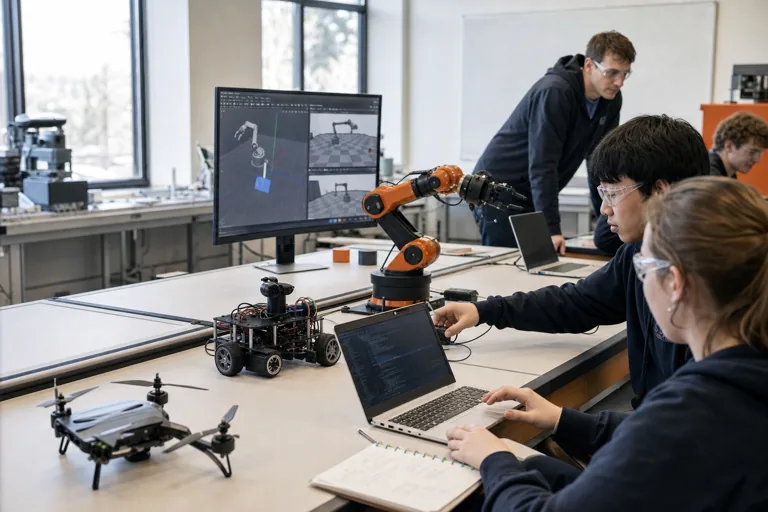
A robot-localization tool for changing sensor combinations and error while viewing the estimate and its uncertainty
The final package includes runnable instructions, the feature and interface design, normal and failure tests, one documented revision, and a three-minute explanation in the student's own words.
Eight introductory sessions
The 20 courses are eight-session CIT studios in which students understand a public university or lab project, confirm a working example, and then turn it into a small robotics application with a useful feature and an operator interface. Selected courses add an optional LLM explanation tool that can read run records but cannot control the robot. RoboMaster has 28 sessions, and implementation scope is adjusted to each student's experience and computer access.
Open the web notebook and review usage limits
Describe screen positions with numbers
Calculate the direction a robot moves
Understand landmarks and sensor information
Change only the sensor error
Implement the student-owned feature: A feature that adds, removes, or adds error to a sensor and recalculates how much the robot's position estimate changes
Build the operator interface: A localization screen with a sensor-error slider and a map showing the estimated position and uncertainty area
Integrate, test, and demonstrate: A robot-localization tool for changing sensor combinations and error while viewing the estimate and its uncertainty
Public project used in class
Public projects can change over time. To keep the class example consistent, CIT uses version 49315552e7f6 of gtbook/robotics. CIT checked it on 2026-08-14; it was created on 2026-01-10. Usage-rights note: BSD-3-Clause for repository code; book prose has separate terms.
49315552e7f6The student raises the sensor error and watches how far the robot loses track of itself. In class the project is separated into five boxes (input, memory, process, output, control). The lesson opens one of them, changes one value, and leaves the rest closed.
The sensor reading each notebook takes in, and the action the robot just made
The probability spread across every place the robot could be
The computation that redistributes those probabilities when a new reading arrives
The corrected probabilities, and the next action chosen from them
The order that alternates acting and observing
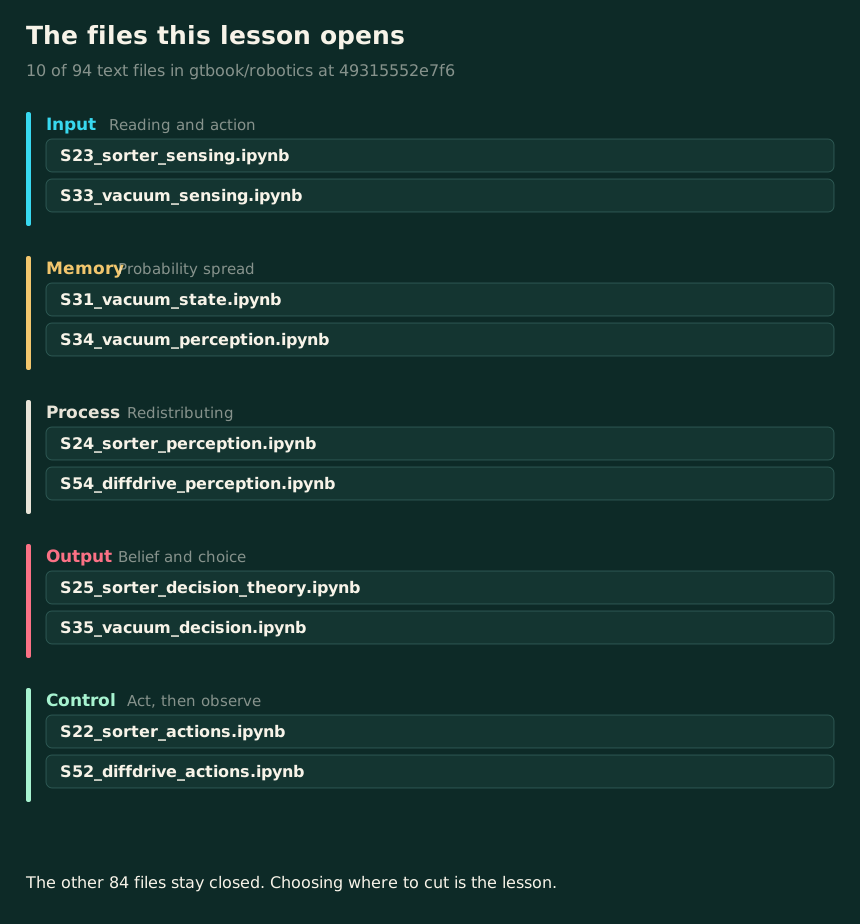
The files the lesson opens, by name. The course is not a walk through the repository; it opens a chosen few and says which.
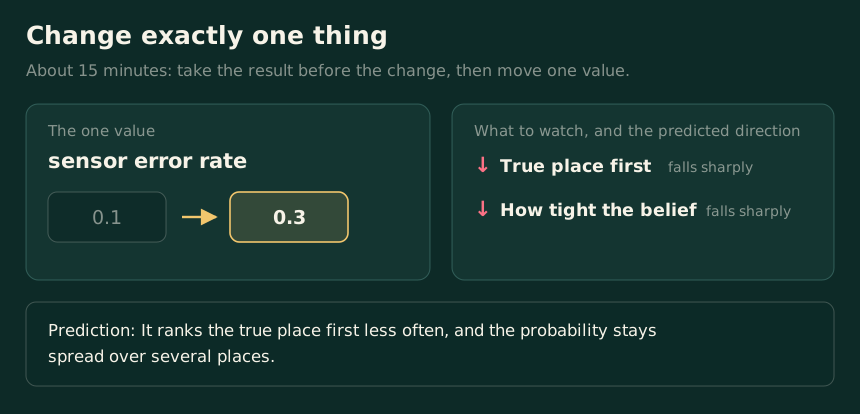
One value moves and everything else stays. The right-hand column is the prediction written before the run, not a result; the work is reconciling the two.
On a narrow screen, swipe the picture sideways.
The universities and labs named here made the open projects this course reads. CIT designed the course independently; it is not an official, affiliated, or endorsed course.
 UIUC LeKiwi: Build and Test a Simulated RobotChange the body, wheels, joints, weight, and friction of a simulated robot and see how each value affects its...→
 RoboMaster: Responding to Voice, Gesture, and Vision SafelyCombine voice, gesture, camera, and distance signals to move a robot. Build safeguards that stop it when...→
 Stanford robosuite: How Robot Arms Pick Up ObjectsRun a simulated robot arm that lifts an object or opens a door. Change the camera position and movement method...→
Clear answers about what students do, what they need, and where the project came from.
University and lab names show where each public project came from. CIT independently designed these courses; they are not official university courses, partnerships, or endorsements.
Not required. The course starts with a robot on the computer or a saved recording of a completed run. Computer guidance: Binder or a standard notebook.
Recommended level: Beginner. Students should be able to follow a guided Python example, test one controlled change, and then build and explain a small feature and interface.
The completed project is A robot-localization tool for changing sensor combinations and error while viewing the estimate and its uncertainty. The student implements A feature that adds, removes, or adds error to a sensor and recalculates how much the robot's position estimate changes and A localization screen with a sensor-error slider and a map showing the estimated position and uncertainty area.
Explain the source research question, method, evidence, and limits first. Then separate the student's own feature and interface decisions, normal and failure tests, revisions, and next question. The source institution's name does not imply affiliation or guarantee admission.
CIT reviewed version 49315552e7f6 of gtbook/robotics on 2026-08-14. That version was created on 2026-01-10. We keep this version during class so the example does not change unexpectedly, and we check the setup again before teaching.
Yes. This course is offered online and in person at CIT in Apgujeong, Gangnam-gu, Seoul, with one-to-one and small-group options. Placement and current availability are confirmed after a readiness consultation.
Before placement, we check the student's coding and math experience, available computer, interests, and ability to explain what happened.
Request a course consultation