Skip to content
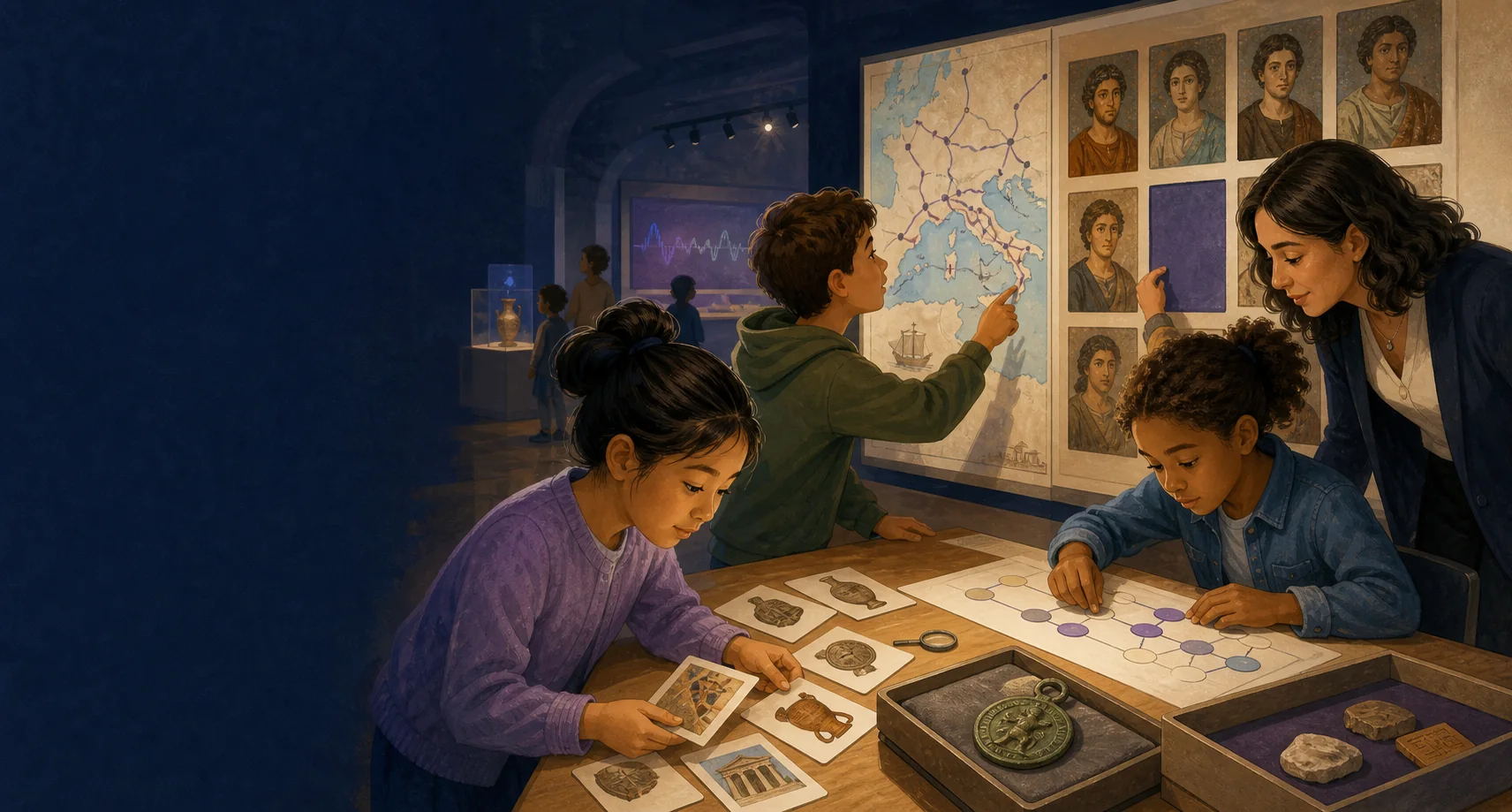
Children investigating maps, portraits, evidence cards, and signals in the Museum of Time and Memory

Grades 3-5 · 12 missions · No coding prerequisite

Time Travelers
& Brain Detectives

Twelve museum missions connect historical evidence, data, memory, brain signals, and fair AI.

Students
Grades 3-5
Ages 8-11
Format
12 sessions
60-75 minutes
Prerequisite
No coding
experience required
Tools
Scratch
cards and small tables
Final work
Time and Mind
Museum

What does this course teach?

It does not stack history, math, psychology, neuroscience, and AI as separate topics. Every concept begins with concrete evidence and one decision.

This is not a course about memorizing history. It is a course about thinking from evidence.

Students observe and predict first, then inspect a card, map, graph, or public object record. They express the reasoning as a Scratch rule, repair a deliberate AI mistake, and explain both the evidence and its limits in their own words.

The lesson structure combines CIT's original missions with the Library of Congress approach to primary-source analysis and Scratch's creative project environment.

External institutions provide factual boundaries and research context. They do not operate or certify this CIT course.

Twelve missions become one museum

Each chapter contains three missions. Open a chapter to see the student output and the central reasoning task.

CH 01 Evidence and historical routesObservation, representation, time, and cost
  1. 01
    The Mysterious Suitcase

    Separate observation, inference, and guess in a Scratch evidence board.

  2. 02
    Missing from the History Wall

    Count cards and explain representation gaps with a pictograph.

  3. 03
    The Roman Messenger Race

    Compare time, synthetic cost, and constraints using ideas from Stanford ORBIS.

CH 02 Connections, artifacts, and languageNetworks, Digital Giza, and context
  1. 04
    The Secret Letter Spiderweb

    Turn people into nodes and letters into edges, then limit what the network can claim.

  2. 05
    The Mystery Object from Giza

    Separate facts, interpretation, and unknowns in a Harvard Digital Giza record.

  3. 06
    The Feeling-Word Trap

    Repair a word rule that misses negation, contrast, and mixed meaning.

CH 03 Classification, memory, and brain signalsConflicting clues, adult study design, signal and noise
  1. 07
    The Time Detective Machine

    Use features and labels, but output unknown when clues conflict.

  2. 08
    The Magic Memory Challenge

    Distinguish an adult study design from a small, local memory game.

  3. 09
    The Brain Signal Radio

    Find patterns and noise in a synthetic waveform without pretending it reveals thoughts.

CH 04 Fair AI and the final museumChoice, train/test, and a parent demonstration
  1. 10
    The Fair Museum Robot

    Ask about stated needs, preserve choice, and provide a human override.

  2. 11
    Teach the Artifact AI

    Keep training and unseen test cards separate, then expose biased-example errors.

  3. 12
    Build the Time and Mind Museum

    Combine sources, graphs, errors, uncertainty, and fairness in at least three rooms.

In 65 minutes, a real object record becomes a careful museum label

Students do not invent a story from an image. They read five public fields in Harvard Digital Giza Object 9678, then separate what the record says from what remains unknown.

Object
Bronze amulet of Apis bull
Classification
Jewelry & adornment, amulets and pendants
Material
Bronze
Dimensions
Width 1.4 cm · length 2.2 cm
Findspot
Avenue G 2, debris
Check the Harvard Digital Giza record
  1. 7 min
    Mystery opening and prediction

    Predict the small bronze object's role, but keep the idea in a prediction box.

  2. 10 min
    Verify the public record

    Connect classification, material, units, and findspot to their field names.

  3. 28 min
    Worksheet and Scratch curator

    Complete five fact buttons, a source button, and an unknown button.

  4. 12 min
    Repair an invented AI story

    Correct the mistake that turns debris into evidence of a specific owner.

  5. 8 min
    Curator explanation and parent note

    Point to one fact, one careful interpretation, and one unknown.

Twelve visible pieces of evidence, not one score

Students earn each badge through an artifact and an explanation, not a quiz score alone.

  1. Evidence and history

    1. 01Evidence Sorter
    2. 02Record Bias Detective
    3. 03Route Optimizer
  2. Connections and context

    1. 04Network Connector
    2. 05Careful Curator
    3. 06Context Reader
  3. Memory and signals

    1. 07Uncertainty Classifier
    2. 08Memory Study Designer
    3. 09Signal and Noise Reader
  4. Fair AI and completion

    1. 10Fair Rule Designer
    2. 11Train and Test Builder
    3. 12Museum Architect

We study minds and brains without analyzing the child

Scientific curiosity and privacy protection are taught as the same design responsibility.

What the course uses

  • Fictional evidence cards and CIT synthetic data
  • Public adult-study design and aggregate-level facts
  • A one-time local memory game with a delete control
  • Synthetic waveforms for explaining EEG principles
  • Unknown, refusal, and ask-a-human routes
  • Teacher-curated, non-sensitive archaeology objects

What the course does not create

  • Child emotion, psychology, memory, or ability profiles
  • Face, location, health, biometric, or neural datasets
  • Claims that AI reads thoughts or diagnoses people
  • Uploaded, ranked, or long-term student scores
  • An unrestricted public chatbot as the core activity
  • Human-remains imagery or life-harm ethics scenes

EEG records electrical activity through scalp electrodes. Interpretation needs context and expertise, and a signal is not a sentence containing a thought. NCBI EEG overview · NINDS testing overview

At the end, parents become the museum visitors

The student guides visitors through at least three rooms. Instead of pretending AI is perfect, the demonstration makes sources, graphs, errors, uncertainty, and human help visible.

Compare other CIT programs
  1. ROOM 01

    Historical evidence

    Source cards, a representation graph, and the boundary between fact and inference.

  2. ROOM 02

    Memory and signals

    Synthetic or local data, signal and noise, and a clear no-diagnosis boundary.

  3. ROOM 03

    Fair AI

    Train and test cards, a deliberate error, user choice, and human review.

  4. DEMO

    Three-minute student tour

    The student explains the strongest evidence and the most important limitation.

University and public sources are used within exact boundaries

CIT wrote the student activities, datasets, dialogue, rules, and Scratch structures. External sources establish facts and research context.

Questions parents usually ask

Which grades is this course designed for?

The core course is designed for grades 3-5, approximately ages 8-11. Grades 1-2 can use an adult-guided eight-module adaptation.

Can a child start without coding experience?

Yes. No text-coding experience is required. Students begin with evidence cards, visual explanations, and Scratch starter specifications, then complete conditions and variables step by step.

Is this a history course or an AI course?

It is an interdisciplinary course joined by one question: what evidence supports this claim? Students read historical evidence, compare it with graphs, and express the same reasoning through Scratch rules and small classification systems.

How much psychology and neuroscience does the course include?

It covers observable concepts such as attention, memory, context, choice, signal, and noise. It does not diagnose students or claim that AI can read thoughts.

Does CIT store a child's feelings or memory scores?

No. The course creates no child emotion, psychology, memory, face, location, biometric, or neural profiles. A memory-game result stays briefly on the local device and is not uploaded, ranked, or linked to a name.

What can a student show at the end?

The student demonstrates an interactive Time and Mind Museum with at least three rooms. It includes a graph, a classification rule, an AI error, sources, a memory or brain-signal limit, fairness, and a human-help route.

What do parents receive after each lesson?

Every lesson includes what the child learned, one question to ask at home, and a privacy and safety summary. The course ends with a three-minute student-led museum tour for parents.
The right starting point is set through consultation

We consider reading and explanation level, Scratch experience, and interest in history or mysteries, not grade alone. Mission order and pacing can be adjusted to the student.

+82 2 540 2922 Apgujeong onsite · online 1:1 or small-group (1:n) 한국어로 읽기