Financial data literacy
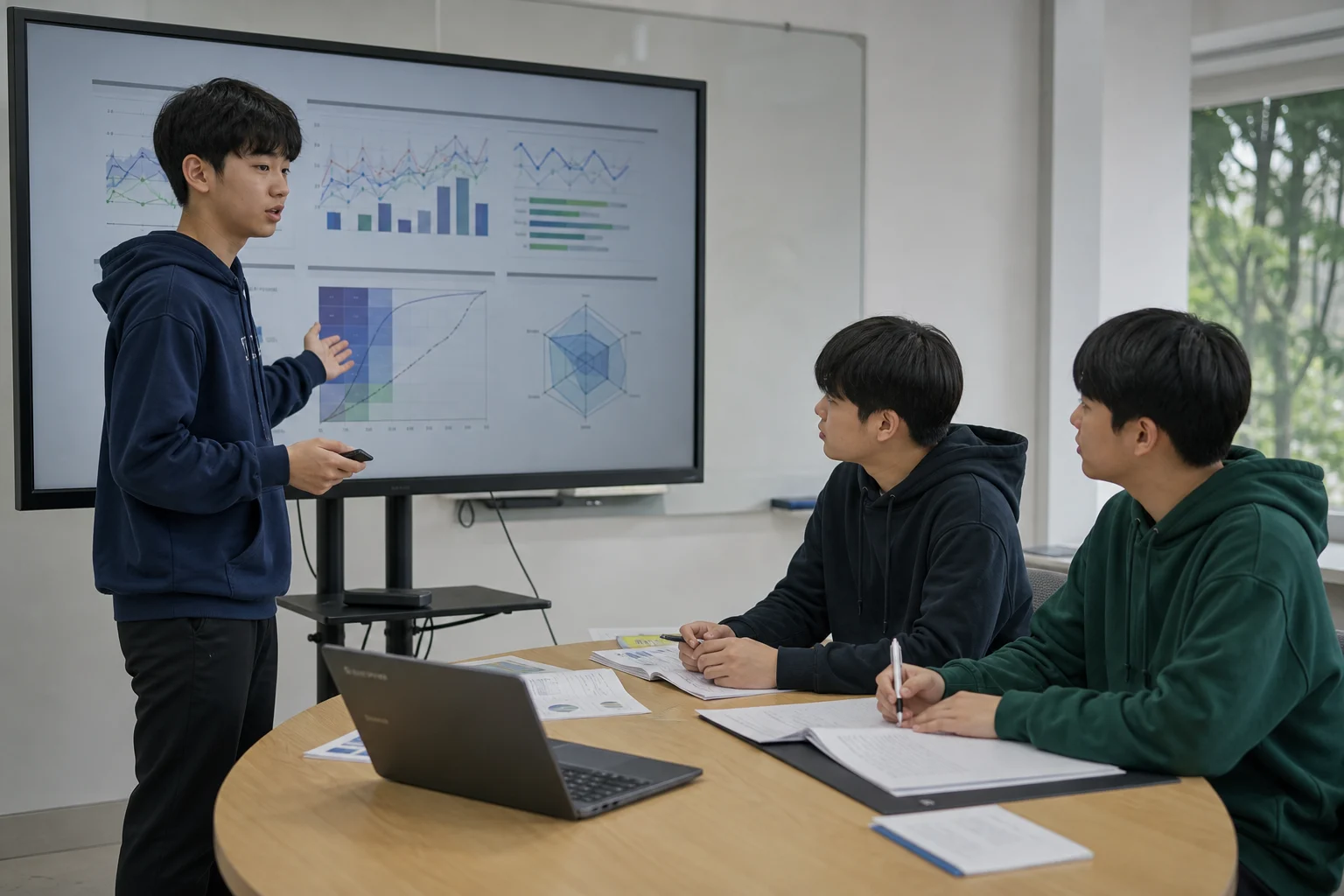
Reproduce timing, returns, risk, and baselines in guided notebooks and explain them in two minutes.
16-week high-school research studio
Test data timing, baselines, costs, errors, and risk before celebrating a financial AI performance curve.
MIT · Harvard · Stanford · Wharton · ChicagoAn independent CIT course that clearly separates official teaching, faculty research code, and university-linked open-source projects.
Research and simulation onlyNo real money, brokerage accounts, personal financial data, or security recommendations. This course does not provide investment, tax, legal, lending, or credit advice.

Core questionCould we have produced this result at that time, after costs, and reproduce it now?
Students read public or synthetic financial data, build simple baselines, then compare ML, optimization, NLP, and agent simulations. Every conclusion carries a timestamp, cost assumption, repeat range, failure case, and human review boundary.
Evidence map
Official courses, faculty research code, and university-linked open source are not equivalent. Students verify where each resource came from and the conditions under which it can be used.
CIT is not an official partner, accreditor, or credit-granting unit of these universities or projects. The links make the curriculum's evidence and code provenance transparent.
Four evidence levels
All students share the same 16-week questions and safety rules. Code depth, primary-source reading, and independence change.
Grades 9-12 are the recommended age range. Students may change paths after a diagnostic or during the term. Lessons run in person in Apgujeong or online across Korea and overseas, one-to-one or in a small group (1:n).
Reproduce timing, returns, risk, and baselines in guided notebooks and explain them in two minutes.
Compare time splits, costs, small models, and optimization on one evaluation table.
Run a scaled replication and analyze sensitivity to seeds, costs, and subconditions.
Operate a reproducible repository, red team, and external review, then defend the work.
16-week curriculum
Each week includes a 180-minute guided lab and 90 minutes of independent work. Fixed snapshots and synthetic fallbacks preserve the research decision when a tool or restricted service is unavailable.
The final evidence package lets another reviewer find the basis and boundary of every major claim.
Five capstone tracks
Every track uses public or synthetic data. Security recommendations, live trading, and personal financial decisions are outside the capstone boundary.
Non-negotiable boundaries
A no-trading boundary makes room to investigate failures in models, markets, and claims honestly.
Primary sources
CIT does not copy university courses. We use official pages to verify questions, tool boundaries, and usage conditions, then write original high-school explanations, synthetic data, labs, and rubrics.
Reviewed 2026-08-27 / repositories, licenses, APIs, and links rechecked before teaching
Relationship notice: University and project names identify the sources of public teaching and research materials. This CIT course is not official, affiliated, endorsed, accredited, credit-bearing, or guaranteed by any listed institution.
Python and statistics experience, the student's finance research interest, and independent-work habits help determine the starting path.
No. There is no real money, brokerage account, trading API, leverage, or live order. Work stays inside public snapshots and synthetic simulations.
No. It is an independent CIT course that labels official teaching, faculty research code, and university-linked open source separately. It does not imply affiliation, endorsement, accreditation, credit, or admission benefit.
Yes. Foundation uses guided notebooks and synthetic data for returns, risk, timing, and baselines. Experienced students deepen implementation through Applied, Research, or Studio.
No. Students learn the access pattern, then complete the core analysis with a public snapshot or synthetic fallback using the same schema. Account sharing is not allowed.
No. CIT does not collect real account, income, credit, transaction, debt, or family financial information. Public, synthetic, and aggregated data are used.
A reproducible repository, data card, non-AI baseline, evaluation and errors, model or system card, red-team results, research poster, and six-minute defense.
We assess current experience and research interests, then place the student from Foundation through Studio.