
Understand the source
- 01
Check whether the older software can run safely
- 02
Understand the simulated drone and its surroundings
Public research sourceHarvardEdge Computing Lab
First understand what Harvard researchers are trying to learn through Edge Computing Lab, why the question matters, how they test it, and what the result cannot prove. Change the number of obstacles or camera error and see how a simulated drone's crash rate and route change. The student then completes A drone-training simulator for building obstacle scenes and testing both learned behavior and an independent safety stop. For a college application or interview, the student separates the source research from their feature, interface, tests, failures, and revisions. Available online or in person in Apgujeong, in one-to-one or small-group formats.
University and lab names show where each public project came from. CIT independently designed these courses; they are not official university courses, partnerships, or endorsements.
Primary routes
CIT keeps the international-school route first, followed by the separate science and gifted-school route.
CIT lessons can run online across Korea and overseas or in person in Apgujeong. The student owns the question, code, tests and explanation; classes do not guarantee admission, selection or awards, and online delivery never changes an institution's submission rules.
Safely study an older public drone-learning project in a current environment. Use saved runs to compare how obstacles and camera errors affect crashes.
Students first use a small working example to understand the researchers' question, method, and evidence. A controlled change helps identify what the student's extension must solve. The student then implements a useful feature, connects an operator interface, and tests the integrated application in normal, boundary, and failure cases.
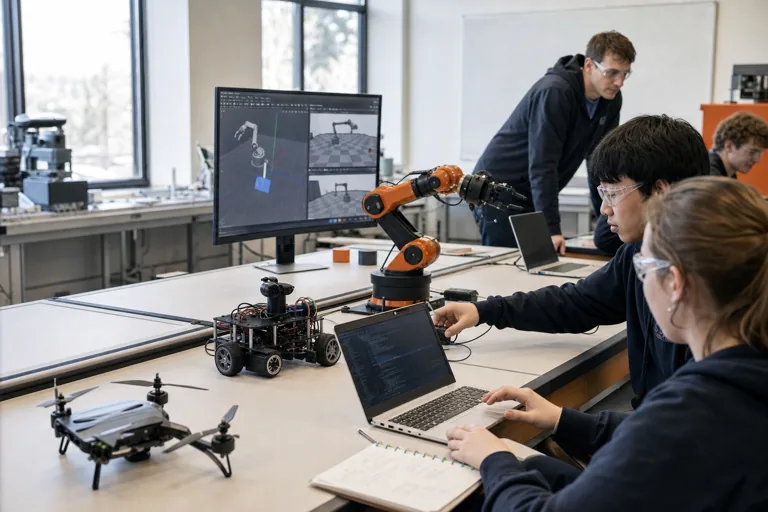
A drone-training simulator for building obstacle scenes and testing both learned behavior and an independent safety stop
The final package includes runnable instructions, the feature and interface design, normal and failure tests, one documented revision, and a three-minute explanation in the student's own words.
Eight introductory sessions
The 20 courses are eight-session CIT studios in which students understand a public university or lab project, confirm a working example, and then turn it into a small robotics application with a useful feature and an operator interface. Selected courses add an optional LLM explanation tool that can read run records but cannot control the robot. RoboMaster has 28 sessions, and implementation scope is adjusted to each student's experience and computer access.
Check whether the older software can run safely
Understand the simulated drone and its surroundings
Understand action scores and one practice attempt
Run the basic obstacle scene
Change only obstacle count or camera error
Implement the student-owned feature: A feature for creating obstacle scenes and stopping independently of the learned policy when collision risk becomes high
Build the operator interface: A drone-test screen showing obstacle layout, flight path, collision rate, travel distance, learning score, and safety stops
Integrate, test, and demonstrate: A drone-training simulator for building obstacle scenes and testing both learned behavior and an independent safety stop
Public project used in class
Public projects can change over time. To keep the class example consistent, CIT uses version 9ec5bab2bbec of harvard-edge/AirLearning. CIT checked it on 2026-08-14; it was created on 2021-09-13. Usage-rights note: No license file found at review; inspect upstream terms before reuse.
9ec5bab2bbecThis course works from a pinned version of harvard-edge/AirLearning. Which files it opens, and what it changes, is still being written; it goes here when it is ready.
The universities and labs named here made the open projects this course reads. CIT designed the course independently; it is not an official, affiliated, or endorsed course.
 Stanford CARLO: Safe Intersection ExperimentsMove cars and pedestrians through a simple on-screen intersection. Change speed and the rule that chooses...→
 UPenn HALO: Finding Drone Targets from LanguageStudy a simulated drone using one camera to find a target named in words. Compare its route and success when...→
 Stanford robosuite: How Robot Arms Pick Up ObjectsRun a simulated robot arm that lifts an object or opens a door. Change the camera position and movement method...→
Clear answers about what students do, what they need, and where the project came from.
University and lab names show where each public project came from. CIT independently designed these courses; they are not official university courses, partnerships, or endorsements.
Not required for simulation. The course starts with a robot on the computer or a saved recording of a completed run. Computer guidance: Preflight older AirSim, Unreal, and CUDA dependencies.
Recommended level: Advanced, legacy. Students should be able to follow a guided Python example, test one controlled change, and then build and explain a small feature and interface.
The completed project is A drone-training simulator for building obstacle scenes and testing both learned behavior and an independent safety stop. The student implements A feature for creating obstacle scenes and stopping independently of the learned policy when collision risk becomes high and A drone-test screen showing obstacle layout, flight path, collision rate, travel distance, learning score, and safety stops.
Explain the source research question, method, evidence, and limits first. Then separate the student's own feature and interface decisions, normal and failure tests, revisions, and next question. The source institution's name does not imply affiliation or guarantee admission.
CIT reviewed version 9ec5bab2bbec of harvard-edge/AirLearning on 2026-08-14. That version was created on 2021-09-13. We keep this version during class so the example does not change unexpectedly, and we check the setup again before teaching.
Yes. This course is offered online and in person at CIT in Apgujeong, Gangnam-gu, Seoul, with one-to-one and small-group options. Placement and current availability are confirmed after a readiness consultation.
Before placement, we check the student's coding and math experience, available computer, interests, and ability to explain what happened.
Request a course consultation