College application research evidence · understanding and original contribution · Seoul and online
Project courseThe student keeps the work and the record they made.
AI Money Lab: Forecasting, Pricing & Data Products
Grades 6-8: store profit and loss, demand forecasts, and...
Where this course comes fromThe universities and labs named here made the open projects or materials this course draws on. CIT designed the course independently; it is not an official, affiliated, or endorsed course of those institutions.
- MITTool used in class
- Free consultation and level check
- Apgujeong classroom or online
- One-to-one or small group
- Registered academy no. 11882

Is AI Money Lab: Forecasting, Pricing & Data Products a good fit for middle school students in Grades 6-8?
AI Money Lab: Forecasting, Pricing & Data Products is a good fit for students in grades 6-8 who are interested in store profit and loss and demand forecasts. CIT offers online or in-person lessons in Apgujeong, Gangnam, Seoul, in one-to-one or small-group formats. Students make a store profit dashboard, a forecast-based ordering helper, and a working AI store with a portfolio.
The course runs on MIT App Inventor, made by MIT. Students in Grades 6-8 run a pop-up store on play money and synthetic class data instead of real money or customer records, calculating revenue, fixed and variable costs, profit, and break-even points to see why selling more can still lose money. They forecast sales from weather, social media mentions, and past sales, score the forecasts by mean absolute error (MAE), and compare pricing, recommendations, and A/B tests on customer satisfaction and fairness as well as profit. The last unit turns a problem found in role-played interviews into a small AI store that students demo and defend out loud. The student then designs and tests an extension of their own: a new question, feature, model, interface, or solution. In an application or interview, the student separates the source research from their own decisions, results, failed attempts, revisions, and limits.
Google sign-in is required. Existing account permissions determine access.
My child loved that the teacher explained things really well and made the lesson enjoyable. We are very glad too.
- Age group
- Grades 6-8
- Academic subject
- Economics & Business, AI & Data, Mathematics & StatisticsBrowse subject
- Course type
- Course
- Format
- Online or Apgujeong in person · one-to-one or small group
- Teaching language
- Korean by default, with complete English materials
- Curriculum status
- Lesson-readyEvery learning item includes the evidence, worked example, practical work, and tutor guidance required by CIT's lesson-ready standard.
From open research to student-owned work
Students inspect a relevant public source, reproduce the idea, then add an original question, feature, or test. The material this course reads was made at MIT. Names identify the source, not affiliation or endorsement.
- MITTool used in class
How can I explain this course to my child?
If questions about store profit and loss or demand forecasts keep making you ask why, AI Money Lab: Forecasting, Pricing & Data Products lets you investigate the question with evidence, then build and defend an extension of your own.
Which interests suggest this course?
- store profit and loss
- demand forecasts
- fair pricing and recommendations
What does the student finish?A store profit dashboard, a forecast-based ordering helper, and a working AI store with a portfolio.
Is this a good fit?
A strong fit for students considering economics, business, finance, entrepreneurship, policy, or product management.
Beginners can use guided templates.
Comfort with ratios, tables, or simple graphs is helpful.
Students should be ready to revise work after feedback.
What will my child learn?
- Calculate revenue, fixed and variable costs, profit, break-even quantity, and inventory cost to explain a business decision.
- Split data into training and test periods in time order and score demand forecasts by mean absolute error.
- Tell correlation from causation and design a randomized A/B test that holds other conditions fixed.
- Compare pricing strategies and recommendation rules on satisfaction and fairness, and audit them for dark patterns.
- MITTool used in class
How does the course progress?
- 1Understanding a Store's Revenue, Costs, and Profit
Calculate revenue, total cost, profit, break-even points, and inventory cost for four products, then link them in a store dashboard.
- 2Predicting What Will Sell
Clean synthetic demand data, compare the errors of a previous-day baseline and a social media rule, and build an ordering helper.
- 3Comparing Pricing and Recommendation Methods
Weigh price elasticity, recommendation rules, conversion, retention, and randomized A/B tests by profit, satisfaction, and fairness.
- 4Building a Small AI Store
Define a problem through role-played interviews, then add a data dictionary, a baseline, privacy and bias checks, and a live demo.
What counts as useful evidence?
A store profit dashboard, a forecast-based ordering helper, and a working AI store with a portfolio.
What should an admissions reader be able to see?
The course runs on MIT App Inventor, made by MIT. The student designs and tests features, models, and screens of their own with it. In an application or interview, the student separates the tool they used from their own decisions, results, failed attempts, revisions, and limits.
Useful evidence may include a market analysis, policy model, data product, decision memo, or tested business idea. Claims should stay tied to the evidence.
These names identify who published the open project the course starts from. The evidence an application reads is what the student understood, completed, and can explain.
Open the detailed program pageThe system this course takes apart
- the subject the small business a student runs, and its forecast
- 5 boxes
- no external code repository
The student separates their own business into five boxes and compares results while keeping the rule of changing one value at a time. In class the thing the student works on is separated into 5 boxes; the lesson opens one of them and changes one thing.
- InputWhat comes in?
Last week's price, batch size, units sold and leftover stock, plus the one value being changed this week
- MemoryWhat persists?
The diagnosis table stacking units, revenue, total cost and profit row by row
- ProcessWhat transforms?
Forecasting next week's sales and computing the gap between forecast and actual
- OutputWhat leaves, and who uses it?
Next week's batch size and price, with the record of why
- Controlopened hereWhat decides when anything runs?
The rule for when a value changes and when it stays; change something every week and nothing explains the result
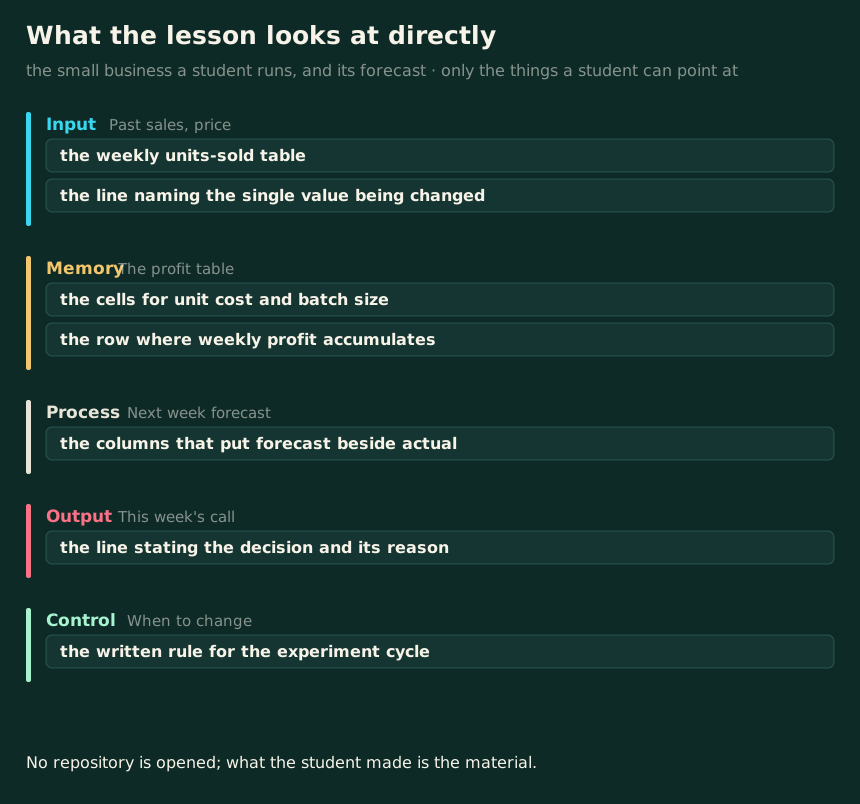
This course reads no public code repository: the tables and records the student makes are the material.
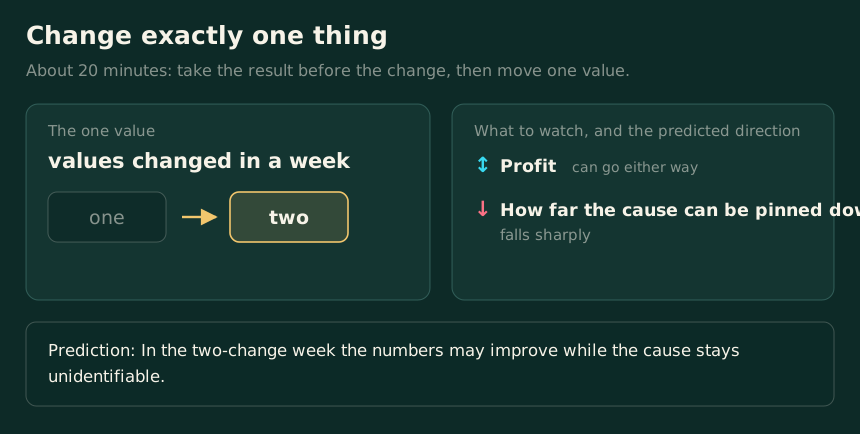
One value moves and everything else stays. The right-hand column is the prediction written before the run, not a result; the work is reconciling the two.
On a narrow screen, swipe the picture sideways.
The universities and labs named here made the open projects this course reads. CIT designed the course independently; it is not an official, affiliated, or endorsed course.
Which sources were reviewed?
Catalog reviewed: 2026-09-30
- MITTool used in class
Questions parents search before choosing this course
Is AI Money Lab: Forecasting, Pricing & Data Products a good fit for middle school students in Grades 6-8?
AI Money Lab: Forecasting, Pricing & Data Products is a good fit for students in grades 6-8 who are interested in store profit and loss and demand forecasts. CIT offers online or in-person lessons in Apgujeong, Gangnam, Seoul, in one-to-one or small-group formats. Students make a store profit dashboard, a forecast-based ordering helper, and a working AI store with a portfolio.
Can my child take AI Money Lab: Forecasting, Pricing & Data Products online or in person, one-to-one or in a small group?
Yes. CIT offers online and in-person lessons at its Apgujeong academy in Gangnam, Seoul, with one-to-one and small-group options. A readiness consultation confirms the available format and starting point for the course.
Does my child need prior subject knowledge or coding experience for AI Money Lab: Forecasting, Pricing & Data Products?
Beginners can use guided templates. Comfort with ratios, tables, or simple graphs is helpful. Students should be ready to revise work after feedback.
What will my child make or practice in AI Money Lab: Forecasting, Pricing & Data Products?
The main evidence is a store profit dashboard, a forecast-based ordering helper, and a working AI store with a portfolio. Students also document decisions, tests, feedback, and limits in age-appropriate language.
How can AI Money Lab: Forecasting, Pricing & Data Products show research understanding in a college application?
The course runs on MIT App Inventor, made by MIT. The student designs and tests features, models, and screens of their own with it. In an application or interview, the student separates the tool they used from their own decisions, results, failed attempts, revisions, and limits. Useful evidence may include a market analysis, policy model, data product, decision memo, or tested business idea. Claims should stay tied to the evidence.
How are the schedule and tuition for AI Money Lab: Forecasting, Pricing & Data Products determined?
CIT confirms the student's readiness, goal, location, class size, and current availability before recommending a course plan. The consultation and level check are free; tuition is explained before enrollment.
When should a student start?
There is no fixed intake month. CIT reviews the student's current school term, readiness, and available hours, then names the point in the course where they should begin.
The teachers are always attentive and considerate, so we feel comfortable trusting them with our child.
Where else parents check CIT
Choose the course after a readiness check
CIT can compare this course with nearby options by age, subject, and current preparation.