한국어 안내

16-week high-school studio

AI + ManagementFrom model to market.

A 16-week studio connecting model performance to user value, product KPIs, and responsible launch decisions. Available online or in person in Apgujeong, in 1:1 and small-group (1:n) formats.
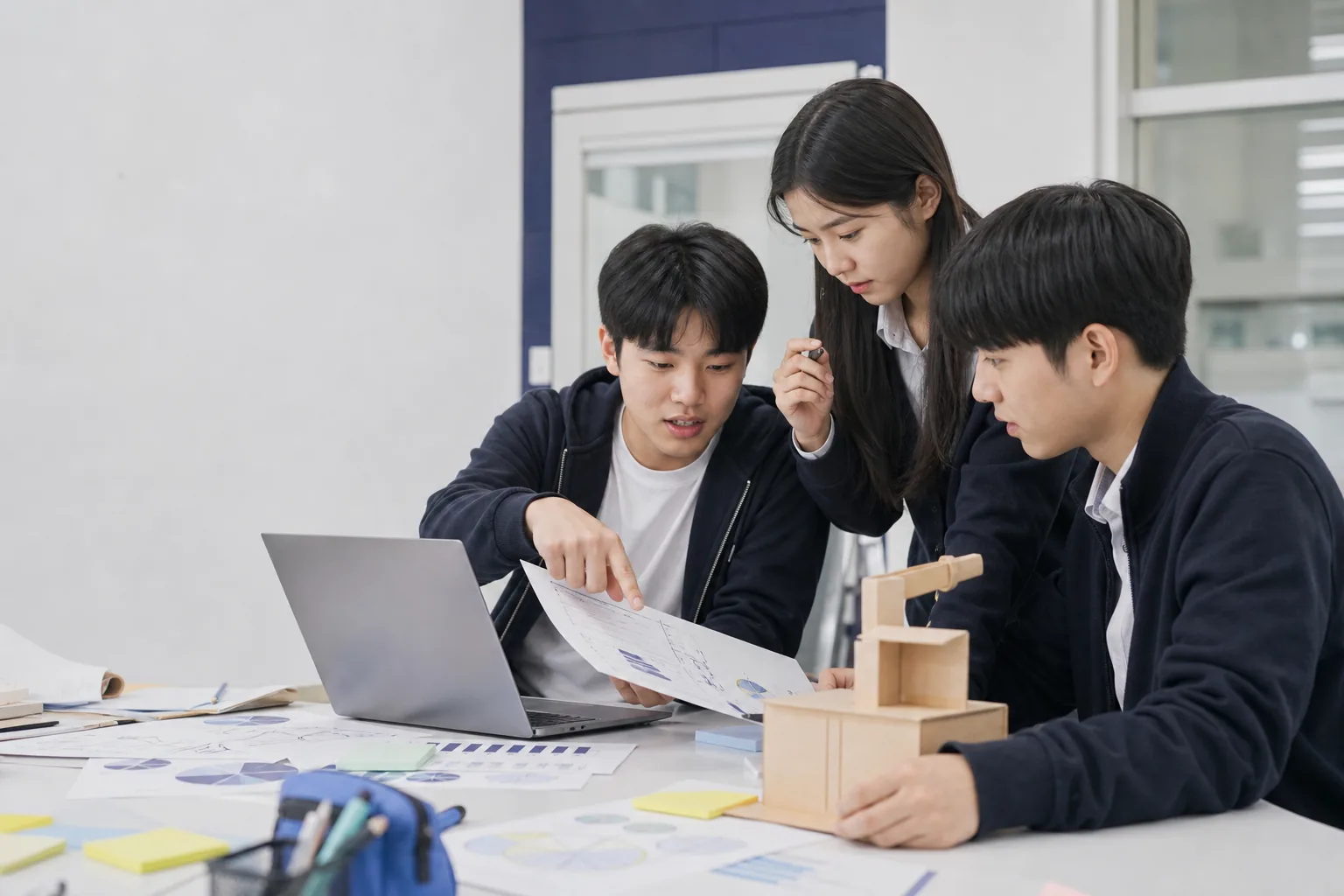
High-school students discussing an AI product decision around a laptop and paper prototype
Students review a product idea together with its evaluation evidence.

Core questionWhat evidence supports the product decision, beyond the model score?

16 weeksone studio each week
72 hoursguided + independent
4 levelsreadiness-based routes

AI and management
are not two subjects.

Here, AI is not simply a tool that produces an answer. It is a system students evaluate before making a product decision.

Students frame the problem, inspect data, build a baseline, and evaluate a model. They connect the evidence to a PRD, KPIs, cost, risk, and a launch decision.

50%AI, data, models
30%product, business
20%ethics, teamwork
  1. ProblemIdentify whose problem matters
  2. DataRecord source, unit, quality, limits
  3. Baseline + AICompare on the same evaluation set
  4. Product KPITest the user task and operating cost
  5. DecisionChoose go, iterate, or stop

Four readiness levels

Start by readiness,
not by grade.

Every student works through the same 16-week problems and safety requirements. Implementation depth, tools, and independence change.

Grades 9-12 are the recommended age range. Placement follows a diagnostic, and a student can change routes during the term.

Foundation

AI literacy

Reproduce a key calculation with guided notebooks and synthetic data, then explain it in two minutes.

Evidence data notebook, simple app, two-minute explanation
Applied

ML and MVP

Build a small model and MVP, then revise a PRD-lite and sprint from user-task evidence.

Evidence ML report, MVP, PRD-lite, retrospective
Advanced

Model and product analytics

Compare subgroups, sensitivity, model KPIs, and product KPIs in a decision memo.

Evidence experiment, model card, KPI dashboard, memo
Studio

Product, venture, responsibility

Manage scope and risk gates, then defend a bounded launch decision for a capstone.

Evidence repo, evaluation report, business decision, pitch

16-week curriculum

Learn, build,
then decide.

Each week includes a 180-minute guided studio and 90 minutes of independent work. Detailed lesson materials are available in the tutor and student LMS.

W01-04

Problem, execution, data, baseline

  1. W01What AI should and should not solve
  2. W02Python, Jupyter, and team operations
  3. W03Data literacy and an EDA memo
  4. W04ML baseline and success metric
W05-08

Evaluation, MVP, Korean NLP, decisions

  1. W05Confusion matrix and metric decision
  2. W06App Inventor MVP and user test
  3. W07Stanza Korean NLP and user value
  4. W08Search, games, and trade-off decisions
W09-12

Performance, responsibility, safety

  1. W09Deep learning cost-performance lab
  2. W10Robustness, bias, and model cards
  3. W11mini-HELM and product KPIs
  4. W12Age-appropriate AI safety audit
W13-16

Business judgment and capstone studio

  1. W13Opportunity, customer, value, cost
  2. W14Capstone sprint and baseline
  3. W15Validation and launch decision
  4. W16Demo day, pitch, postmortem

Beyond a list of activities.
Evidence for every decision.

Artifacts show what a student compared, why a choice was made, and what evidence would change the decision.
  1. Data and model evidenceEDA memo, non-AI baseline, ML and NLP experiments, confusion matrix, subgroup evaluation
  2. Product evidenceProblem statement, PRD-lite, MVP, user-task test, product KPIs
  3. Decision evidenceMetric decision, model card, safety audit, business and launch memos
  4. Operations evidenceGitHub issues and PRs, sprint board, reviews, AI-use log
  5. Capstone evidenceReproducible repository, evaluation report, five-minute demo, pitch, postmortem

Different interests.
The same evidence standard.

  • Korean AI Study Assistant Evaluator
  • Sports Team Decision Lab
  • Local Business AI Product
  • School Sustainability AI
  • Accessible School App
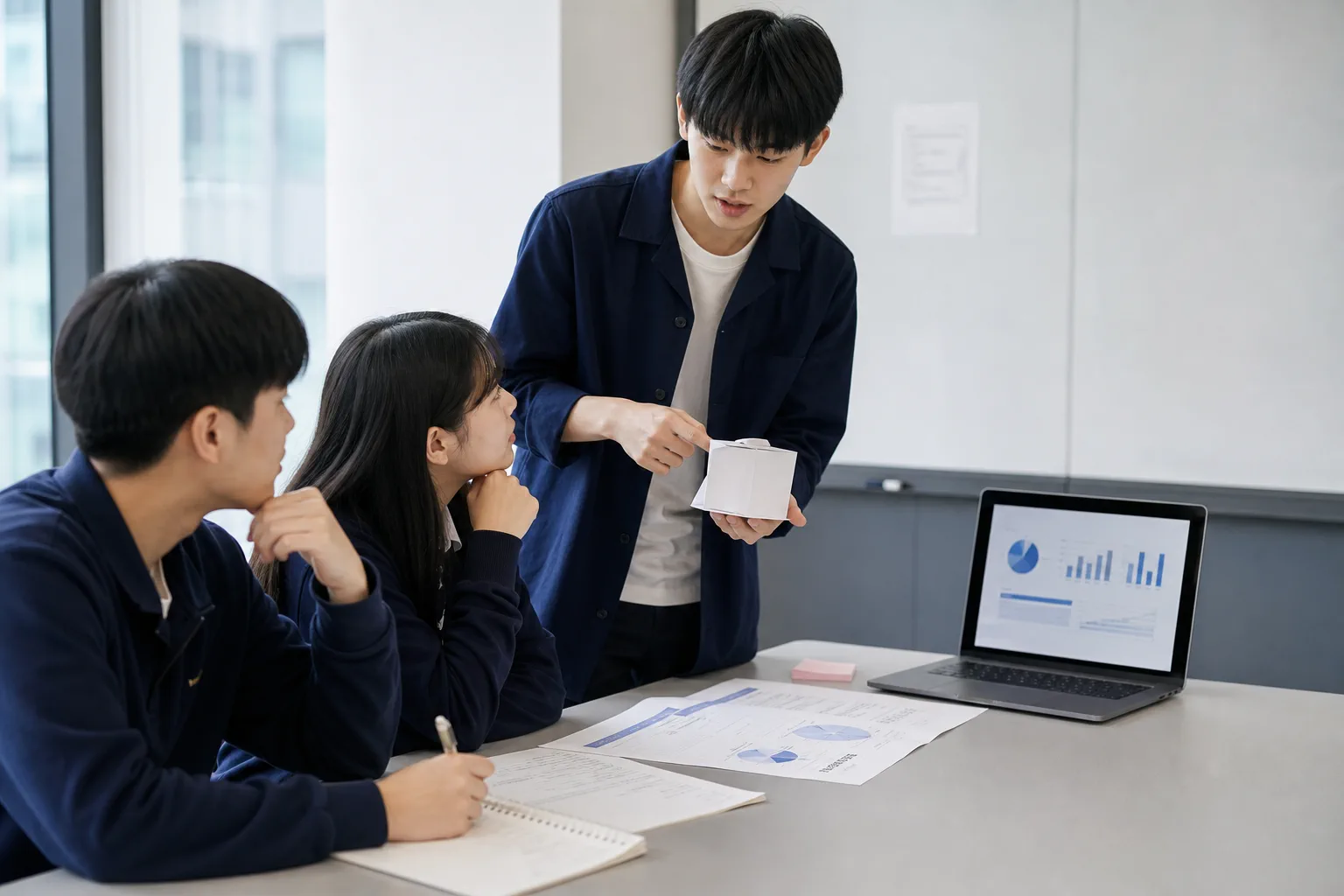
High-school students presenting and reviewing an AI product prototype with evaluation evidence
The team explains its product evidence and defends the final launch decision.

The learning record parents can review

  • Weekly artifacts and the next improvement question
  • Student-written decision memos and reflections
  • GitHub evidence connecting code, data, and evaluation
  • What AI assisted and what the student decided
  • Final demo, pitch, postmortem, and next roadmap

Safety boundaries applied to every project

  • No collection of students' personal, sensitive, face, location, health, home, or grade data
  • Public, synthetic, and aggregate data with source and version records
  • No products that automatically score, profile, or monitor students
  • Explicit uncertainty, refusal, human help, retention, and deletion paths
  • An AI-use log plus live student explanation and modification

Standards and sources

Official frameworks
set the boundaries.

We do not copy university courses. Official sources define concepts and tool boundaries; CIT writes original high-school explanations, synthetic data, problems, and rubrics.

Last reviewed: 2026-08-13 / Official documents and tool status are checked before teaching

Education and competence

Product and execution

Models and risk

Questions to answer
before starting

A student's current Python experience, interests, and independent work habits help us choose the right entry route.

01Can a student with no Python experience start?

Yes. Foundation begins with guided notebooks and fixed synthetic data. Students who can work with functions and tables can move into Applied, Advanced, or Studio work.

02Is placement fixed by grade?

No. The course serves Grades 9-12, but readiness matters more than grade. Students enter after a diagnostic and can change routes during the course.

03How are AI and management balanced?

The recommended balance is 50 percent AI and data, 30 percent product, project, and business decisions, and 20 percent ethics, teamwork, and communication.

04What can parents review?

Parents can review weekly data memos, notebooks, baseline comparisons, a PRD-lite, model cards, decision memos, and sprint records. The final package includes a repository, evaluation report, demo, pitch, and postmortem.

05Does the course use students' personal data?

No. Projects do not collect or profile students' personal, sensitive, face, location, health, home, or grade data. Public, synthetic, and aggregate data are preferred.

06Must students launch a real company?

No. The course does not promise revenue or launch. Students use evidence about user value, cost, risk, and product KPIs to choose a pilot, iteration, or stop decision.

Strong AI work starts
at the right level.

We review current experience and interests, then choose a route from Foundation through Studio.

Request a course consultation