College application research evidence · understanding and original contribution · Seoul and online
Project courseThe student keeps the work and the record they made.
Smart Money Makers: AI, Data & Mini Business
Grades 3-5: sales versus profit, fair surveys and bar...
Where this course comes fromThe universities and labs named here made the open projects or materials this course draws on. CIT designed the course independently; it is not an official, affiliated, or endorsed course of those institutions.
- MITTool used in class
- Free consultation and level check
- Apgujeong classroom or online
- One-to-one or small group
- Registered academy no. 11882

Is Smart Money Makers: AI, Data & Mini Business a good fit for elementary students in Grades 3-5?
Smart Money Makers: AI, Data & Mini Business is a good fit for students in grades 3-5 who are interested in sales versus profit and fair surveys and bar graphs. CIT offers online or in-person lessons in Apgujeong, Gangnam, Seoul, in one-to-one or small-group formats. Students make a mini-shop profit dashboard, survey bar graphs, and a kind-business prototype with a one-minute pitch.
The course runs on MIT Scratch, made by MIT. In a Scratch sticker shop that runs on play money, with no real sales or payments, students in Grades 3-5 calculate price, cost, sales, profit, and stock and find that the product with the most sales may not earn the most profit. They run fair surveys without names, count the answers into bar graphs, and test an IF-rule helper and a small sorting helper on the same test cards. To finish, they pick one customer problem and present a kind mini-business prototype with fair pricing and test records in a one-minute talk. The student then designs and tests an extension of their own: a new question, feature, model, interface, or solution. In an application or interview, the student separates the source research from their own decisions, results, failed attempts, revisions, and limits.
Google sign-in is required. Existing account permissions determine access.
As soon as my child got home, they showed me the game they had made. They said it was so much fun.
- Age group
- Grades 3-5
- Academic subject
- Economics & Business, AI & Data, Mathematics & StatisticsBrowse subject
- Course type
- Course
- Format
- Online or Apgujeong in person · one-to-one or small group
- Teaching language
- Korean by default, with complete English materials
- Curriculum status
- Lesson-readyEvery learning item includes the evidence, worked example, practical work, and tutor guidance required by CIT's lesson-ready standard.
From open research to student-owned work
Students inspect a relevant public source, reproduce the idea, then add an original question, feature, or test. The material this course reads was made at MIT. Names identify the source, not affiliation or endorsement.
- MITTool used in class
How can I explain this course to my child?
If questions about sales versus profit or fair surveys and bar graphs keep making you ask why, Smart Money Makers: AI, Data & Mini Business lets you investigate the question with evidence, then build and defend an extension of your own.
Which interests suggest this course?
- sales versus profit
- fair surveys and bar graphs
- helpers that recommend and sort
What does the student finish?A mini-shop profit dashboard, survey bar graphs, and a kind-business prototype with a one-minute pitch.
Is this a good fit?
A strong fit for students considering economics, business, finance, entrepreneurship, policy, or product management.
Beginners can start with visual tools.
Students should be ready to save work and explain a simple choice.
Text coding is introduced only when it supports the project.
What will my child learn?
- Subtract the cost of one item from its price and calculate sales and profit separately.
- Write survey questions that ask one thing at a time and explain results with the mode, mean, and sample size.
- Split example cards into training and test sets before comparing the errors of a rule helper and a small classifier.
- Build a helper that does not force a recommendation when nothing fits, then test it with six kinds of input.
- MITTool used in class
How does the course progress?
- 1My First Smart Shop
Calculate price, cost, sales, profit, and stock, then use Scratch variables for low-stock alerts and a profit dashboard.
- 2Data Detectives
Count fair survey answers into bar graphs and use the mode and mean to estimate what to prepare and how much.
- 3Train a Smart Helper
Test an IF-rule helper and a small classifier on training and test cards, then study wrong and unsure answers.
- 4Build a Kind Business
Combine a customer problem, fair pricing, a three-screen prototype, and a one-change feedback test into a short presentation.
What counts as useful evidence?
A mini-shop profit dashboard, survey bar graphs, and a kind-business prototype with a one-minute pitch.
What should an admissions reader be able to see?
The course runs on MIT Scratch, made by MIT. The student designs and tests features, models, and screens of their own with it. In an application or interview, the student separates the tool they used from their own decisions, results, failed attempts, revisions, and limits.
Useful evidence may include a market analysis, policy model, data product, decision memo, or tested business idea. Claims should stay tied to the evidence.
These names identify who published the open project the course starts from. The evidence an application reads is what the student understood, completed, and can explain.
The system this course takes apart
- the subject the small shop a student runs in class
- 4 boxes
- no external code repository
The student separates their own shop into four boxes, changes one price, and checks how the sales record moves. In class the thing the student works on is separated into 4 boxes; the lesson opens one of them and changes one thing.
- InputWhat comes in?
What customers need, and what the supplies cost
- Memoryopened hereWhat persists?
The record of what sold, how many, and how much came in
- ProcessWhat transforms?
Setting the price, making the thing, and selling it
- OutputWhat leaves, and who uses it?
What went to the customer, and what money is left
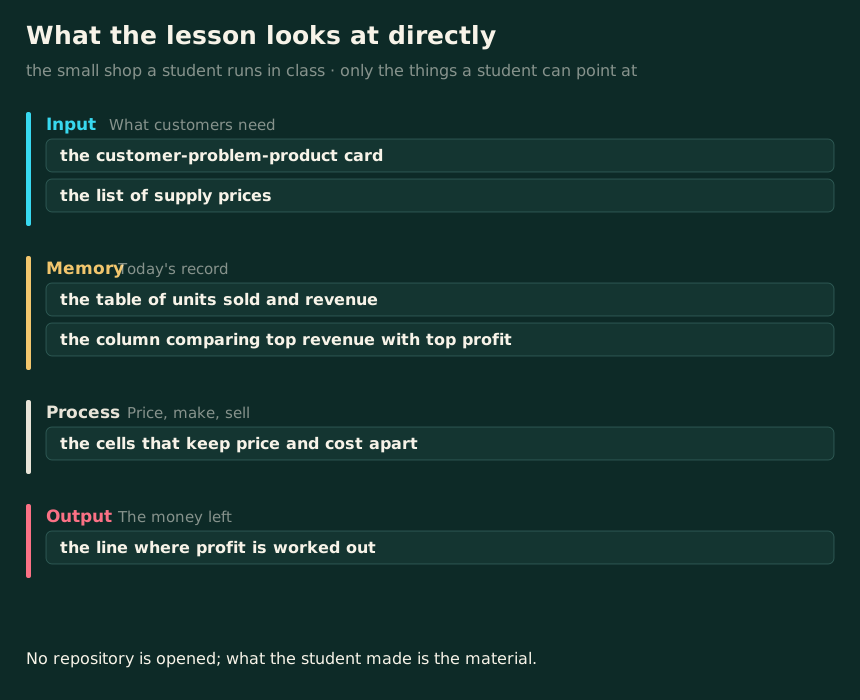
This course reads no public code repository: the tables and records the student makes are the material.
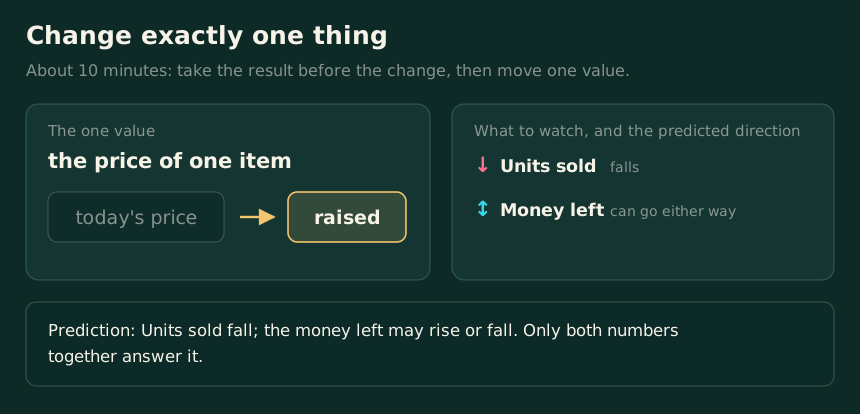
One value moves and everything else stays. The right-hand column is the prediction written before the run, not a result; the work is reconciling the two.
On a narrow screen, swipe the picture sideways.
The universities and labs named here made the open projects this course reads. CIT designed the course independently; it is not an official, affiliated, or endorsed course.
Which sources were reviewed?
- www.consumerfinance.gov
- Scratch · Variables and Lists learning resource
- AI4K12 · Grade Band Progression Charts
Catalog reviewed: 2026-09-30
- MITTool used in class
Questions parents search before choosing this course
Is Smart Money Makers: AI, Data & Mini Business a good fit for elementary students in Grades 3-5?
Smart Money Makers: AI, Data & Mini Business is a good fit for students in grades 3-5 who are interested in sales versus profit and fair surveys and bar graphs. CIT offers online or in-person lessons in Apgujeong, Gangnam, Seoul, in one-to-one or small-group formats. Students make a mini-shop profit dashboard, survey bar graphs, and a kind-business prototype with a one-minute pitch.
Can my child take Smart Money Makers: AI, Data & Mini Business online or in person, one-to-one or in a small group?
Yes. CIT offers online and in-person lessons at its Apgujeong academy in Gangnam, Seoul, with one-to-one and small-group options. A readiness consultation confirms the available format and starting point for the course.
Does my child need prior subject knowledge or coding experience for Smart Money Makers: AI, Data & Mini Business?
Beginners can start with visual tools. Students should be ready to save work and explain a simple choice. Text coding is introduced only when it supports the project.
What will my child make or practice in Smart Money Makers: AI, Data & Mini Business?
The main evidence is a mini-shop profit dashboard, survey bar graphs, and a kind-business prototype with a one-minute pitch. Students also document decisions, tests, feedback, and limits in age-appropriate language.
How can Smart Money Makers: AI, Data & Mini Business show research understanding in a college application?
The course runs on MIT Scratch, made by MIT. The student designs and tests features, models, and screens of their own with it. In an application or interview, the student separates the tool they used from their own decisions, results, failed attempts, revisions, and limits. Useful evidence may include a market analysis, policy model, data product, decision memo, or tested business idea. Claims should stay tied to the evidence.
How are the schedule and tuition for Smart Money Makers: AI, Data & Mini Business determined?
CIT confirms the student's readiness, goal, location, class size, and current availability before recommending a course plan. The consultation and level check are free; tuition is explained before enrollment.
When should a student start?
There is no fixed intake month. CIT reviews the student's current school term, readiness, and available hours, then names the point in the course where they should begin.
I worried because it was hard to explain to my child why they should learn coding. Being with friends seems to make the classes enjoyable for them.
Where else parents check CIT
Choose the course after a readiness check
CIT can compare this course with nearby options by age, subject, and current preparation.