What students build
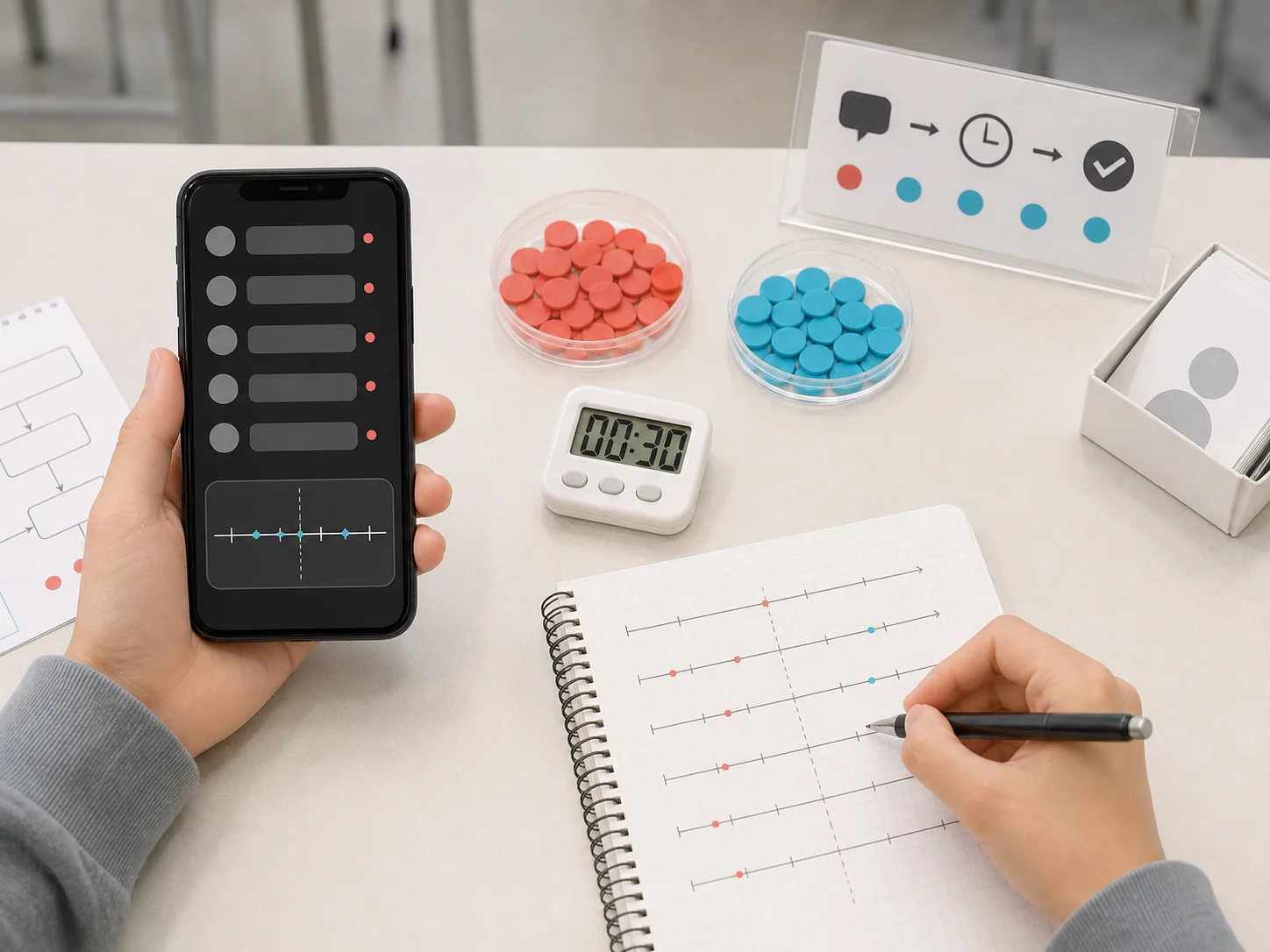
A web experiment that randomizes feedback framing and records retry, strategy-change, or help-seeking choices
Stanford · Stanford Medicine · Harvard public research, independently adapted by CIT
Working from methods Stanford and Harvard researchers published openly, students test questions about friendship, attraction, and relationships with privacy-safe data and AI. They explain what the result supports and what it does not support.

Four live experiments
Every value below is fictional. Change the controls and check how the result and conclusion change.
One attempt at a difficult puzzle did not work. Check the feedback framing before choosing the next action.
Retry52%
Change strategy44%
Ask for help39%
Fictional classroom choice ratesExpected checks7.1
Difficulty estimating reply time0.46
This fictional program does not diagnose smartphone addiction.disappointment cues52%
pressure cues43%
AI gives no answer61%
The program shows cues in the text only. It cannot know the sender's actual feelings.Students predict or touch a visual within 15 minutes and spend at least 45 percent of the session investigating or building.
10 core sessions
Open each session to see the question, main ideas, experiment, completed work, supported statement, and unsupported statement.
After one failed fictional puzzle, choose a next step after neutral feedback, ability praise, or process-and-strategy feedback.
A web experiment that randomizes feedback framing and records retry, strategy-change, or help-seeking choices
A graph of retry and strategy-change rates by feedback condition, plus a result-and-limits note
Check whether prior achievement, task difficulty, peer norms, wording, or condition order changed the result.
Supported statementIn this fictional classroom dataset, retry rates were higher in the process-and-strategy feedback condition.
Unsupported statementGrowth mindset raises every student's grades or changes every student's brain.
Complete a short task in private, instructor-view, and fictional-audience conditions.
A safe web program that records response time, accuracy, confidence, and the order of conditions
A comparison of three audience-cue conditions and two possible explanations
Check whether practice, screen color, or task difficulty affected the result.
Supported statementMeasured performance changed under this fictional-audience condition.
Unsupported statementTeenage brains stop working normally when watched.
Choose different click costs to unlock fictional peer feedback, points, or neutral information.
A record of public-data analysis and a web task using fictional feedback
A graph from public data, a web task, a comparison of two methods, and a limitation
Look for information that can separate curiosity, the game design, and the value of feedback as explanations for effort.
Supported statementIn this task, the number of clicks differed by the type of feedback participants expected.
Unsupported statementThis result reveals who needs approval.
Run fictional messaging programs with different reply probabilities and waiting times.
A fictional messaging program where students can change reply probability, waiting time, notifications, and checking cost
A graph of checks over time and a comparison of two checking methods
Check whether the same result appears with points that have no social meaning.
Supported statementIn our fictional computer experiment, uncertainty about reply timing changed the checking method.
Unsupported statementDopamine makes students addicted to messages.
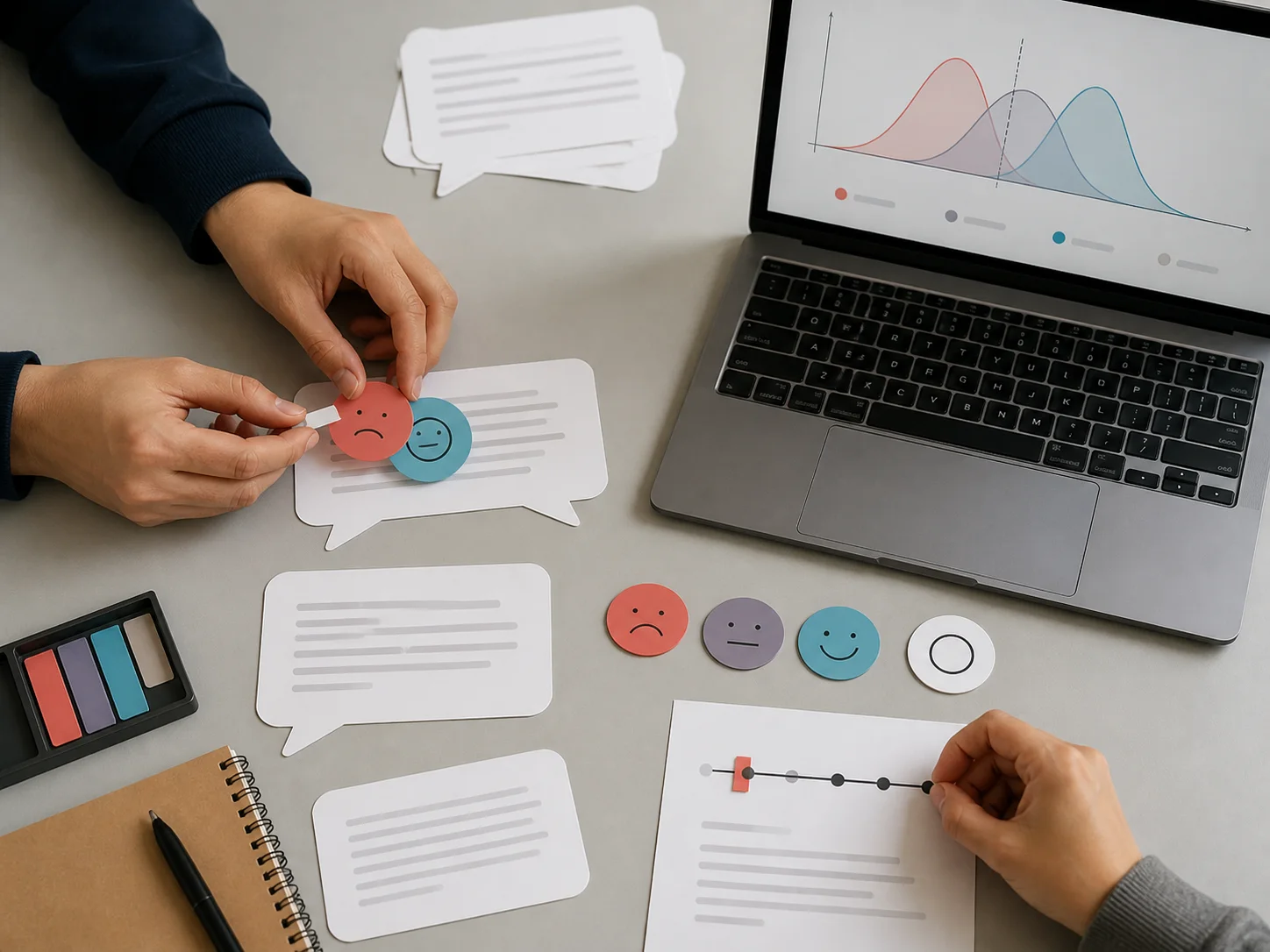
Annotate short fictional Korean messages with multiple cues before viewing any AI output.
A Korean emotion-cue program that compares word rules, a simple AI method, and a more complex AI method, then gives no answer when confidence is low
An error screen, an AI confidence table, and an explanation of when the program gives no answer
Measure how one context line changes human and model judgments.
Supported statementThe text may contain cues of disappointment and pressure, but context is limited.
Unsupported statementAI discovered the sender's true emotion or mental health.
Rate non-sensitive fictional situations from personal, close-friend, and general-peer perspectives without names.
An anonymous results screen showing the spread of answers, number of participants, uncertainty, and errors in estimates of peer views
A graph comparing personal views with estimates of peer views and a caution about comparing Korean and U.S. data
Test question order and socially desirable responding.
Supported statementIn these anonymous responses, personal averages differed from estimated peer averages.
Unsupported statementAll Korean teenagers are misled by peer pressure.
Compare two moving friendship graphs with similar endings but different rules.
A fictional computer experiment that runs friend selection, friend influence, both conditions, and random connections from several starting points
A moving friendship graph, numbers showing how groups formed, and a report comparing settings
Change the starting relationships and random starting value to see whether the same conclusion appears.
Supported statementUnder these settings, friend selection and friend influence both produced similar group patterns.
Unsupported statementThe final friendship graph reveals why the relationships formed.
Choose fictional teammates on one screen that shows images first and another that shows interests, reliability, and communication first.
A fictional profile experiment that records decision time, consistency, remembered information, and variety of choices
A screen comparing the two designs and a redesign that does not pressure users
Separate the effect of first-seen information from the choice mechanic.
Supported statementInterface conditions changed choice patterns and recall in this fictional-team task.
Unsupported statementAn app interface determines whom a student truly likes.
Run two fictional social experiments that differ by only one instruction sentence.
Compare fictional participants that follow fixed rules with AI participants that generate text across several starting conditions, instructions, and memory settings
A comparison of friendship graphs, categories of failed results, a guide to the fictional experiment, and a cost record
Check whether the fictional AI participants simply repeated assumptions that we supplied.
Supported statementUnder these instructions, settings, AI systems, and starting conditions, the fictional participants formed these groups.
Unsupported statementThe fictional AI society shows how real Korean teenagers form groups.
Compare a 2003 study that reported shared brain regions for rejection and physical pain with a 2014 study that separated the two patterns, then mark what each result supports.
Use the open Neurosynth maps to calculate how strongly seeing a brain region supports identifying a feeling, then connect the data, comparison method, results, errors, and limits in one project package
A probability notebook, GitHub project folder, research poster, three-minute explanation, and answers to review questions
Check whether the same brain region appears in unrelated tasks, then name the result that would change the conclusion and the simplest other explanation.
Supported statementState only what the method and participant group support, and do not identify a person's feeling from a brain region alone.
Unsupported statementIt is already proven that rejection uses the same brain circuit as physical pain.
8-session extension
Choose one of three projects. Record the question, sources, data plan, simple comparison, evaluation, repeated tests, results, ethics, and limits.
Review public data and make a safe browser task with fictional feedback.
Show several possible emotion cues, differences between people's answers, AI confidence, and cases where the AI gives no answer.
Compare reply probability, wait time, checking cost, and two ways to estimate when a reply may arrive.
Use public response data to check whether thirty items that claim to measure one idea actually receive similar answers.
A research-question worksheet, a table explaining the main terms, and an analysis of item consistency and grouping using public response data
A research question, prediction, result that would change the prediction, project scope, item-consistency value, and factor structure
Check that the question does not claim to reveal a real person's thoughts, health, or private relationships, and do not draw a conclusion from an unreliable set of items.
Supported statementIn this public sample, the items formed one group and the consistency value fell in this range.
Unsupported statementAI will reveal who likes whom.
Rewrite a strong marketing claim so it matches a paper's method and number of participants.
A source comparison, reference list, and record connecting each claim to the sample size, method, supported wording, and limits
Five core sources with sample sizes and a table of supported and unsupported wording
Remove references that provide a university name but no useful method, and check that a small-sample result was not written as a general fact.
Supported statementEach major claim is linked to the study participants, sample size, method, supported wording, and limits.
Unsupported statementOur conclusion is correct because the research comes from a famous university.
Compare the risks and classroom value of private messages, professionally written fictional messages, public data, and fictional class data.
A data-source table, minimum group size that protects identity, a choice not to participate, an offline alternative, and a research plan saved before results are viewed
A data and ethics plan reviewed by the instructor and a timestamped preregistration
Explain why adding sensitive data for a small accuracy gain is risky, and check whether any part of the plan changed after the results were viewed.
Supported statementThe main question uses public data, professionally written fictional data, or fictional class data, and the analysis plan was saved before results were viewed.
Unsupported statementA friend's messages are safe to analyze after removing the name.
Review a small case where one simple rule nearly matches a more complex AI method.
Build one rule or simple statistical method and keep practice data separate from evaluation data
A working simple comparison, result table, and reason for using it
Check whether evaluation answers were visible during practice and whether one person or conversation appears in both practice and evaluation data.
Supported statementA more complex AI method must show added value over the simple comparison on criteria chosen in advance.
Unsupported statementThe more complex model is automatically more scientific.
Run the same AI method several times with different random starting values and inspect how much the results change.
The final project's more complex AI method or changed-condition experiment with automatic run records
An AI method or experiment, settings file, run record, and first result
Check whether the question or evaluation method changed after viewing the results.
Supported statementAcross several runs with settings chosen in advance, the results fell within this range.
Unsupported statementThe best single run represents the model's ability.
Compare two models with equal accuracy but very different failure types.
A table comparing predicted and actual answers, an AI confidence graph, at least five failed cases, and a review of possible harm
An evaluation report, error screen, and rule for giving no answer
Check whether averages hide failures on short, mixed, or specific conditions.
Supported statementThis rule for giving no answer reduced one type of error but also withheld some correct answers.
Unsupported statementHigh accuracy makes the model trustworthy for every input.
Find a small setting change that alters the conclusion and turn it into a warning or control on the screen.
A results table for changed settings and a web program that shows AI confidence, missing information, corrections, and no-answer results
A report comparing settings, an interactive web program, and a guide to the AI or fictional experiment
Find screens that hide uncertainty or invite users to read estimates as facts.
Supported statementThe result held within this range and changed outside it.
Unsupported statementIt worked once, so it is stable in real settings.
Review an incomplete GitHub project folder and find where another person would be unable to run the work.
A GitHub project folder with a README, software setup, random starting values, sources, run commands, results, ethics, and limits
A GitHub project folder, research poster, three-to-five-minute explanation, and answers to review questions
Explain why the conclusion may change with another random starting value, participant sample, country, or age group.
Supported statementAnother person can check a result within the expected range using the same data and settings.
Unsupported statementPublishing the GitHub project folder makes the finding true for every person and situation.
Three options based on readiness
A student can use the Researcher option for psychology, the Builder option for Python, and the Explorer option for statistics. The option can change as the student learns.
Change one condition on a guided screen and finish a graph and limitation statement.
Modify a simple comparison, an AI method, or a computer experiment with Python and JavaScript.
Read original papers, repeat tests after changing settings, and complete a poster and presentation.
Personal relevance without exposure
Students can study friendship, attraction, and relationships without naming anyone, uploading messages, sharing histories, or accepting diagnosis.
Research sources and limits
Results from U.S. or adult participants are not presented as facts about Korean teenagers. Results from fictional computer experiments are not treated as evidence about real people.
Harvard University
Harvard University
Harvard University
Harvard University
Stanford · UT Austin
Stanford Medicine
Harvard University
Harvard SEAS
Harvard Graduate School of Education
Harvard Graduate School of Education
Boston Children's Hospital
Seoul National University
Harvard and 4 partner institutions
Google DeepMind
UCLA
University of Colorado Boulder
Washington University in St. Louis
Open meta-analysis tool
Open data project
Center for Open Science
This is not an official, certified, or jointly developed course of Stanford University, Stanford Medicine, Harvard University, or any institution shown. CIT independently adapts public research, data, and methods for education.
No. This is not an official, certified, or jointly developed course of Stanford University, Stanford Medicine, Harvard University, or any institution shown. CIT independently adapts public research, data, and methods.
No. Every activity can use friendship, study-group, club, team, or fully fictional scenarios.
Yes. The Explorer option begins with guided screens and data records. Students can do more independent work in the Builder or Researcher option when ready.
No. It supports in-person or instructor-led online delivery in both one-to-one and small-group formats.
Behavioral experiments, data records, computer experiments, web programs, GitHub project folders, guides that explain the AI or computer experiment, a research poster, and a presentation.
We review the student's interests and current Python, mathematics, and statistics readiness to choose the Explorer, Builder, or Researcher option.